TRAVELING- EXHIBITION as a “SPACE OF WORLD-COMPREHENSION”
NICEA I: THINKING AND CONTEMPLATION
Exercising seeing as a relationship: From object to thing
Listen to the RCF Bruxelles radio program with the curators of the exhibition:
“I would like to open new eyes, so to speak, to see it anew, to make everyone aware of a creative power within themselves…” R. Guardini
IDEA:
This exhibition was opened for the first time in February 2025 at the Theological Faculty of the Pontifical University in Rome together with Fr. Renczes sj as part of a conference on Nicea I with the title "... of all things visible and invisible Nicaea I. An Eye-Opener to Synodality" by the organizers and curators Prof. Yvonne Dohna Schlobitten and Fr. Lucian Lechintan sj. and was exhibited again in September of the same year in the Chapelle pour l'Europe in Brussels thanks to Sabina González Vilas with the title "If you leave, you take the Trinity with you...".
Other universities and centers are interested in showing this exhibition in ecumenical and interreligious contexts. Ultimately, it is about practicing a "seeing that loves" by setting in tension the relationship between thinking in contra-position and contemplation, analogous to the Trinity. The exhibition has now been conceived by Professor Yvonne Dohna Schlobitten as a traveling-exhibition as a “Space of World-Comprehension”, allowing it to be shown anywhere in the world with little effort. All that's needed is a room, chairs, a monitor with a screen or just a computer, paper, and pens. Professor Yvonne Dohna Schlobitten would be happy to introduce the pedagogy in person or online, and a small booklet, she has created, provides a theological and philosophical in-depth information on the individual steps.
CONTEXT:
"The earth is becoming ever smaller, distances are shrinking, opportunities for encounters are increasing day by day. But people, and this is one of the most terrible paradoxes of our far from progressive cultural development, seem to be moving ever further away." The root of the problem is the loss of real encounter. We must reconnect with one another, says Guardini. Within the framework of his theoretical and experiential thinking and scientific analysis and research, the scientist can recognize much that is correct and important, but the ‘being’ of things and their relationship to the whole remains hidden because the created or created "thing"'s relationship to God remains invisible. Following Antoine de Saint-Exupéry in his book "The Little Prince," one could also say: "One can only see clearly with the heart. What is essential is invisible to the eye." In the 20th century, Guardini speaks of a crisis of thought, which for him is actually a crisis of faith. Guardini says, "Knowledge is always somehow an encounter in love." This reveals the entire problematic of our modernity, our throwaway society. Since we have attributed the character of objects to things and denied their subjectivity, we believe we can throw them away and destroy them as we please. And since we increasingly degrade people to objects, using and employing them as objects only for their own purposes, profound encounters are becoming increasingly difficult. The digital turn and artificial intelligence (AI) are also making us increasingly incapable of relationships with texts and opinions.
NICE I and NICE II: The first ecumenical Council, Nicea I, returns us to the origin of relationship as a part of creation. Guardini speaks of a creation that is not yet finished and sees us humans as co-creators, as counterparts, as co-responsible, contributing to this world in our freedom and out of our freedom; in a kind of service to creation. "Being free means being able to transcend one's own individuality, bound in so many different ways, and toward that of others." But this requires one thing above all: sympathy. Guardini, along with Holy Scripture, cannot help but give the entirety of God's creation and human creation a character of encounter, promise, and redemption, thus attributing to them those personal qualities that divine creation and human creation bear within themselves as the vestigium Dei. This is the difference from Nicea II, a council that sought to define the function of art for the Church at a historical moment. It was only in the Second Vatican Council that art was again recognized as a place of encounter with God in all its diversity, thus responding to the ecumenical Council of Nicea I, in which all believers agreed: we must enter into a relationship with the creation, because, “We are called by that which is not yet."
THINKING AND CONTEMPLATION:
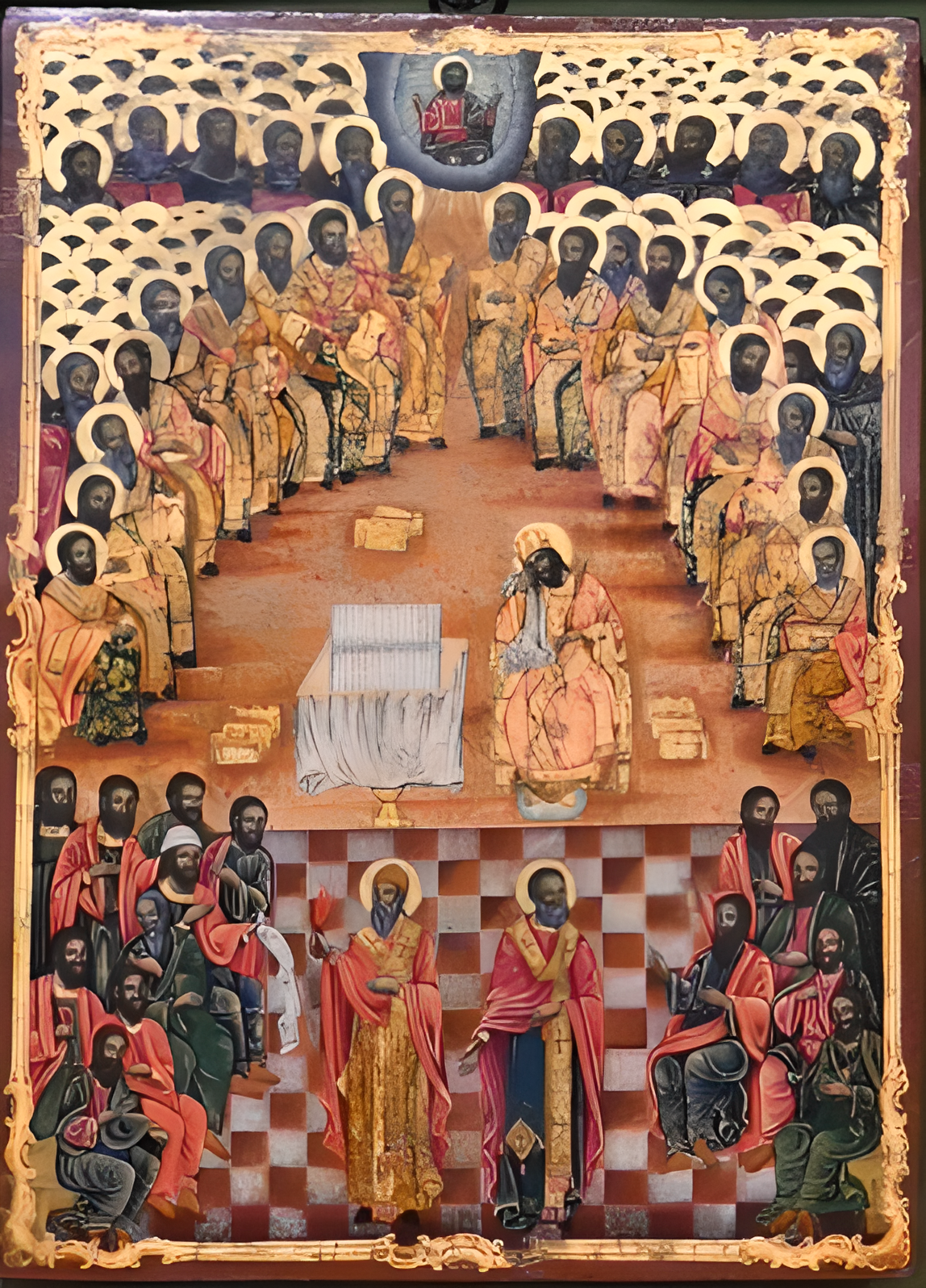
Scholars, mystics, thinkers, saints, and artists have attempted to describe the Trinitarian, "threefold" nature in their writings. A Bulgarian icon illustrates how Trinitarian knowledge of things is to be understood and tells a story from the time of the first ecumenical Council of Nicaea I, clearly showing how the three modes of knowledge relate to one another, equal in tension, neither mixed nor separated. A Bulgarian icon telling a story from the time of the first ecumenical council of Nicea I, clearly shows how the three ways of knowing relate to each other, equally in tension and neither mixed nor separated.
This is depicted in this icon, which is divided into two parts. In the upper part, a man sits, as in Rodin's Thinker, leaning on his hand and pondering, while the open text lies beside him. He thinks and sweats, as if reflecting also on his experience. In the lower part, however, we see the saint's contemplative insight into the brick. A Bulgarian icon not only depicts Saint Spyridon of Trimitonte, Bishop of Cyprus in the time of Nicea I, recognizing the Trinity in a brick in a mystical moment, as fire flickers upwards and water drips downwards while the saint holds the sand in his hands. The sand unites the two incompatible materials, water and fire, into a single entity in the brick, without mixing or dividing their molecules. This is a paradigm for the ‘being’ of all things and their way to be understood. The observer is invited to comprehend the world in this way.
INSTRUCTIONS FOR THE TRAVELING EXHIBITION “WORK-SPACE” - 1 hour
It is an exercise to encounter the tensions in the world as counter-positions and not as contradictions, and thus, instantly bring one back to the inner world, to what we really are, to that unseen side, the not yet known of ourselves that has to reveal our uniqueness. We want to welcome people and offering them a space for a knowledge in relation where they can think the contrapositions together and live them together getting in touch with their own process of knowing on a theoretical, experimental and contemplative level.
INSTRUCTIONS FOR THE TRAVELLING EXHIBITION -LABORATORY (1 hour)
THREEFOLD EXERCISE
- RELATION TO THE WORD
THEORETICAL KNOWLEDGE (15 min)
Take a copy of the CREDO of Nicaea and sit down somewhere and read it.
QUESTION: What do you THINK does the CREDO of Nicaea I tell us about the relationships between God Father, the Son and the Holy Spirit and the things?
- RELATION OF THE WORD AND THE WORK OF ART
EXPERIMANTAL KNOWLEDGE (15 min)
Look at the images of the exhibition.
QUESTION: Where can EXPERIENCE relations and why? Explain your experience of the works of art reflecting on the relationships between God Father, the Son and the Holy Spirit and their relation to humankind?
- RELATION OF MYSELF WITH THE WORLD
CONTEMPLATIVE KNOWLEDGE (15 min)
Sit down in front of the screen and watch the video. You will see couples, confrontating a work of art inspired by Nicea I with a contemporary work of art. Follow the three steps and the three questions indicated in the video.
- Explain what does the pictures make you feel and why?
- Please describe the work of art without interpreting it.
- Are you able to let yourself be looked by the picture?
- Sharing (15 min)
QUESTION: What is your relation to the things and the other in the world?
DEEPER SENSE: I would like to end with a legend: St. Augustine was walking along the beach, trying to understand the mystery of the Holy Trinity—how God can be three persons in one. He saw a boy filling a small hole in the sand with water from the ocean using a seashell. Curious, Augustine asked, “What are you doing?”The boy replied, “I’m trying to fit the entire ocean into this hole.” Augustine smiled and said, “That’s impossible. The ocean is too big for such a small hole.”The boy looked at him and said, “And so is the mystery of God too big for your mind to fully understand.” Then the boy vanished. The lesson? Whatever we meet in the world is a mystery. It is beyond human understanding. We have to be aware of this and be able to encounter and understand in a contemplative knowledge.
BOOK PROPOSAL: Pope Francis, Let Us Dream: The Path to a Better Future,
Beside Guardini’s writings, this book could be a help to understand our exhibition- laboratory: exercising to think in contrapositions. This approach could help to create community and synodality.
The Pope Francis says: “One of the effects of conflict is to see as contradictions what are in fact contrapositions, as I like to call them. A contraposition involves two poles in tension, pulling away from each other: horizon/limit, local/global, whole/part, and so on. These are contrapositions because they are opposites that nonetheless interact in a fruitful, creative tension. As Guardini taught me, creation is full of these living polarities, or Gegensätze; they are what make us alive and dynamic. Contradictions (Widersprüche) on the other hand demand that we choose, between right and wrong. (Good and evil can never be a contraposition, because it is not the counterpart of good but its negation.) To see contrapositions as contradictions is the result of mediocre thinking that takes us away from reality.
This breakthrough comes about as a gift in dialogue, when people trust each other and humbly seek the good together, and are willing to learn from each other in a mutual exchange of gifts. At such moments, the solution to an intractable problem comes in ways that are unexpected and unforeseen, the result of a new and greater creativity released, as it were, from the outside. This is what I mean by “overflow” because it breaks the banks that confined our thinking, and causes to pour forth, as if from an overflowing fountain, the answers that formerly the contraposition didn’t let us see. We recognize this process as a gift from God because it is the same action of the Spirit described in Scripture and evident in history.
Text by Dr Professor Yvonne DOHNA SCHLOBITTEN